
Pine County's Most Wanted Program
Pine County runs no public most wanted gallery, and that is simply how the office works. The sheriff's office publishes tip resources and an investigations page asking the public for help identifying people, but no curated roster with names and photographs appears on it. The agency covers roughly 27,000 residents and visitors across about 1,411 square miles, and it handles warrant service through the same patrol and records channels it uses for everything else. So anyone asking about a Pine County most wanted program gets an honest description of what the office publishes and nothing more. The tip lines are real; the gallery is not.
No Pine County Most Wanted Roster Was Found
Look for a county most wanted page and you will meet a wall of commercial sites, with very little government material behind them. Those commercial pages are not official and have no tie to the court system. The county's own channels offer a dated active-warrant PDF printed in 2021, plus an address-based system linked from the jail page. Neither one is a curated most wanted feature. Neither should be read as a current count of anything.
Note: A curated list changes as cases close, so an old copy proves nothing about anyone's current status.
How the Most Wanted Lists Work
A curated list is a selection, never a census. An agency picks a few cases where public help could matter and posts them with a photograph and a short description. A sheriff sets that bar. The list shifts as cases close. Pine County works under the same limits as anywhere else, and Minnesota's state program follows the same pattern. The Department of Corrections keeps a statewide wanted fugitives resource for people who walk away from supervision, and its scope is state supervision rather than one county's court files. Update cadence varies too. Some agencies refresh weekly. Others let a list sit for months. No Pine County reader should trust a schedule without checking the page itself.
Pine County Tips and the State Wanted Fugitive List
The state resource casts the widest net a Pine County reader can use. It covers people under state supervision, so a tip about someone who left a Minnesota prison or a supervised release program fits there even without a county connection. The program runs a 24-hour tip line at 651-603-0026 and keeps its own case pages. It is a state corrections tool, not a county warrant search. A missing name there does not mean a Pine County warrant is gone. The Minnesota DOC wanted fugitives page is the official state source for the program, its case listings, and its tip line.
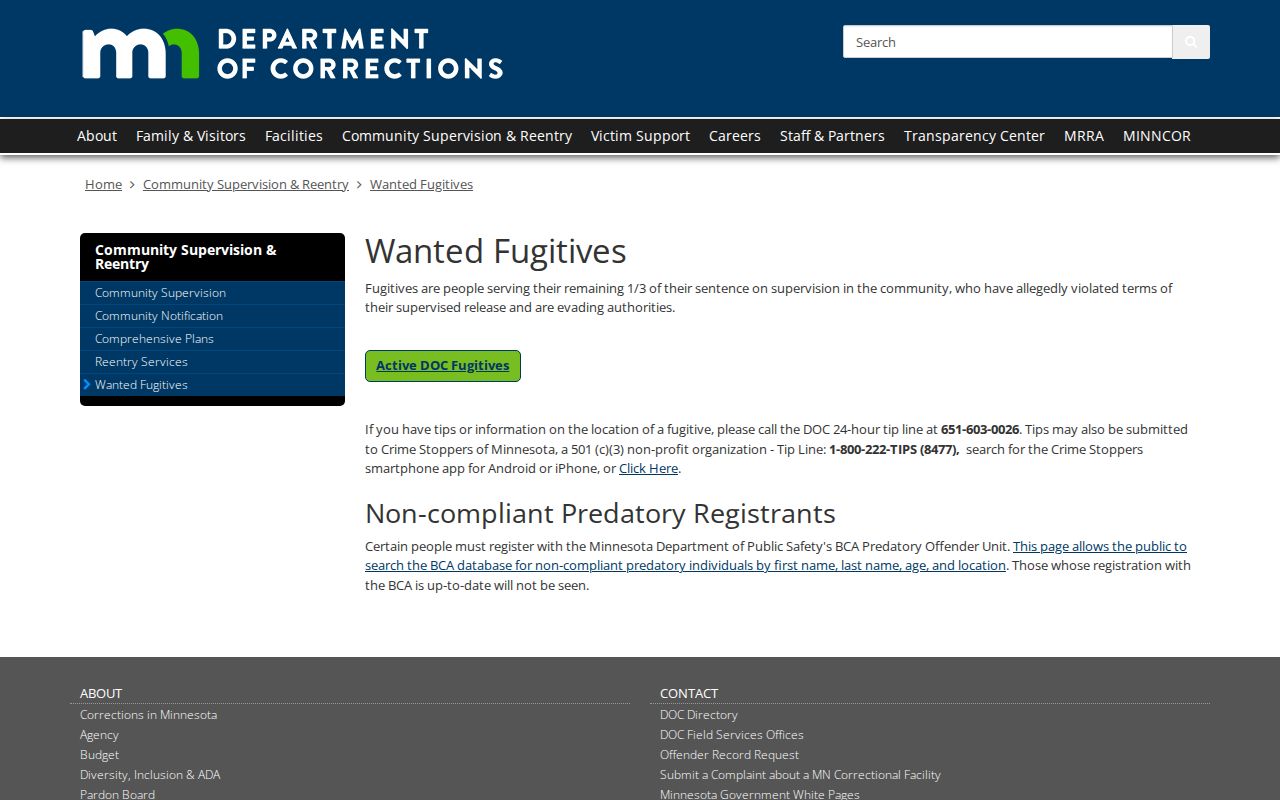
The page reports state supervision cases only. It says nothing about the status of a Pine County court warrant.
Reporting a Tip Safely
Anyone with information about a fugitive case should use an official channel and never approach the person. Every program here takes phone tips. The nonprofit route also takes them online. Crime Stoppers of Minnesota runs an anonymous program with a round-the-clock line at 800-222-8477, a web tip form, and a phone app. A caller does not need to give a name. Caller ID is not required, and translations are available. Pine County residents with a tip can use any of those routes day or night.
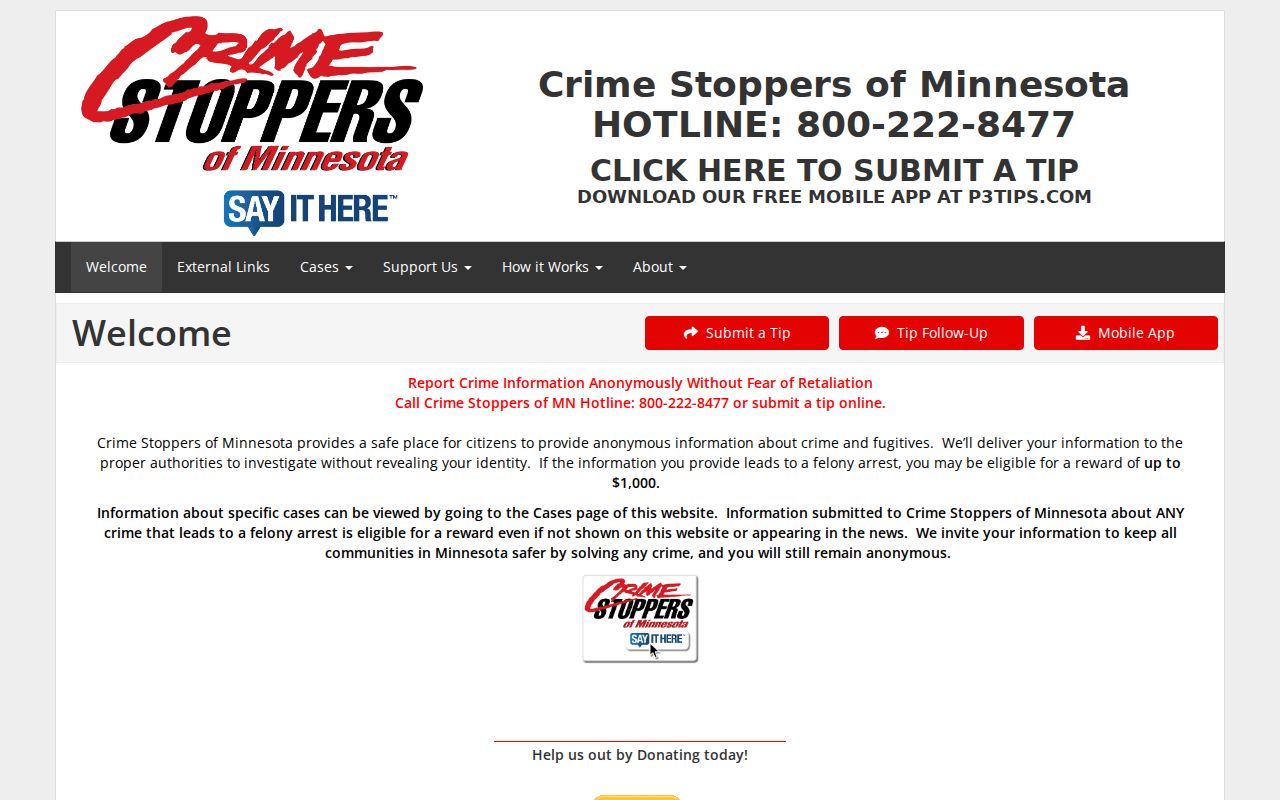
That official page lays out the anonymity promise and every tip channel, with all the details above.
Key Point: A tip goes to an investigator. A tip line is not a warrant lookup, and it is never the way to check your own status.
Pine County Most Wanted Rewards and Tip IDs
Reward programs carry rules, and the rules decide whether a tip ever pays. Crime Stoppers says rewards can reach $1,000 when information leads to a felony arrest or the capture of a fugitive. Featured cases may carry a higher figure the program sets case by case. A board decides the amount. Eligibility depends on sending the information straight to the program before an arrest happens. A tip passed along secondhand does not qualify, a point worth knowing before any Pine County caller counts on a payout.
- Tip ID
- A code the program gives an online tipper so the person can follow up without giving a name.
- Anonymous tip
- A report made without identifying the caller to the investigator.
- Reward
- Money the program may pay after an arrest or capture, subject to its own review.
- Featured case
- A case the program highlights, sometimes with a larger reward attached.
The how-it-works page explains the submission and reward process in the program's own words.
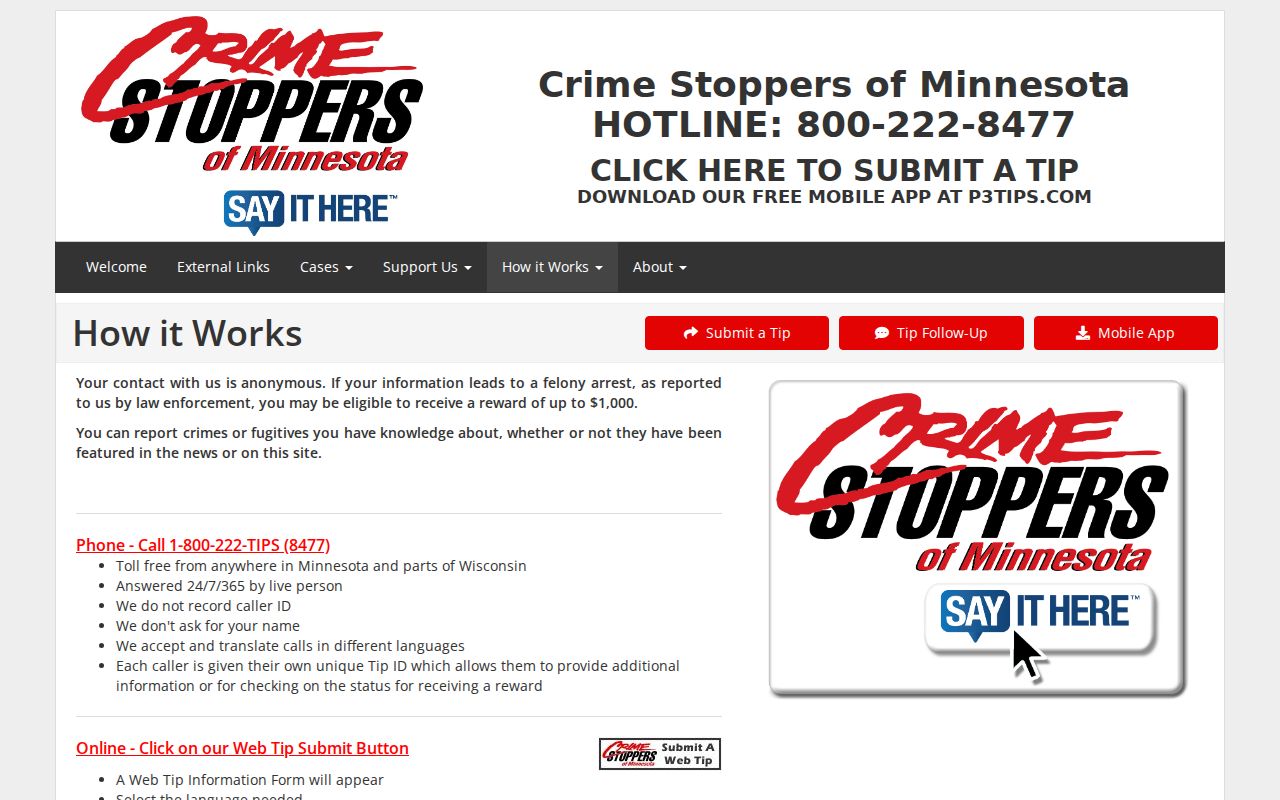
The page covers the reward process only. It carries no roster and no way to look up a person.
Most Wanted Lists vs Active Warrants
A most wanted list and an active warrant list answer different questions, and mixing them up sends Pine County readers to the wrong office.
| Question | Most Wanted List | Active Warrant List |
|---|---|---|
| Who selects it | A public information decision by one agency | The courts and the custody system |
| What it shows | A small set of highlighted cases | Every warrant the listing agency chooses to publish |
| How complete | Deliberately narrow | Broad, and still incomplete on purpose |
| What it is for | Getting public help with a case | Recording the status of a court order |
Under Minn. Stat. §13.82, an arrest-warrant index stays confidential until the person is in custody, served, or appears in court. That rule is why no broad list gives a full picture.
Why a Tip Program Is Not a Pine County Warrant Search
A tip line answers nothing about your own warrant status. Tips travel one way only, toward the investigators who work Pine County cases, and no report ever comes back to the caller. Ringing a tip program to ask about yourself just burns the program's time. It can also start a conversation you never meant to have. The real Pine County warrant search runs in the opposite direction, through the court record. With a name and a case number, you can query the state case system, sit down at the courthouse terminal, or call Court Administration at 320-591-1500 and ask about the file. For warrant status and service questions, the sheriff's records unit at 320-629-8380 is the right desk. A most wanted list plays no part in either route, and having one nearby improves nothing.
If You Think You Are on a List
A most wanted entry is not a court record, so skip the tip line and go to the source. The published description is one Pine County agency's notice to the public; the court file is what actually decides whether a warrant exists. Talk with a lawyer before you act. Then confirm the case with Court Administration at 320-591-1500 or the sheriff's records unit at 320-629-8380. Ask which warrant, which court, and which conditions apply before agreeing to anything.
Important: Speak with a lawyer and confirm the case with the court before acting, and never try to resolve your own matter through a tip program.
No Pine County Warrant Amnesty or Roundup
Plenty of counties run warrant roundups or amnesty weeks where people can surrender safely. Pine County publishes no such event: no named roundup, no safe-surrender window, and no clearing hotline appears from the county, the sheriff, the jail, or the state judiciary. The federal side has the same gap. The U.S. Marshals Service district page for Minnesota lists no profiled fugitive information right now, which is routine rather than a red flag. Federal cases live in a separate court and a separate system anyway. That leaves two honest routes: report someone else's case through the state or a nonprofit, and check your own through the court file.